Can You Do a PhD After BTech in India? Routes, Eligibility and What to Expect
Yes, a PhD after BTech is possible in India. Learn the direct admission rules, GATE and NET options, the M.Tech route, duration, funding and career scope.
Many final year engineering students reach the same quiet crossroads. A job offer may be sitting in the inbox, or campus placements may not have gone as planned, and one thought keeps returning. What if the next step is research instead of a salary? The practical question is simple: can you do a PhD after BTech in India, or must a master's degree come first?
This guide answers it the way a campus mentor would, with rules, timelines and honest trade offs. Whether you study at a large institute or at a growing campus such as Tulas University, the road to a doctorate runs through the same national framework. What changes is how well prepared you are when you step onto it.
The Short Answer Most Engineers Want
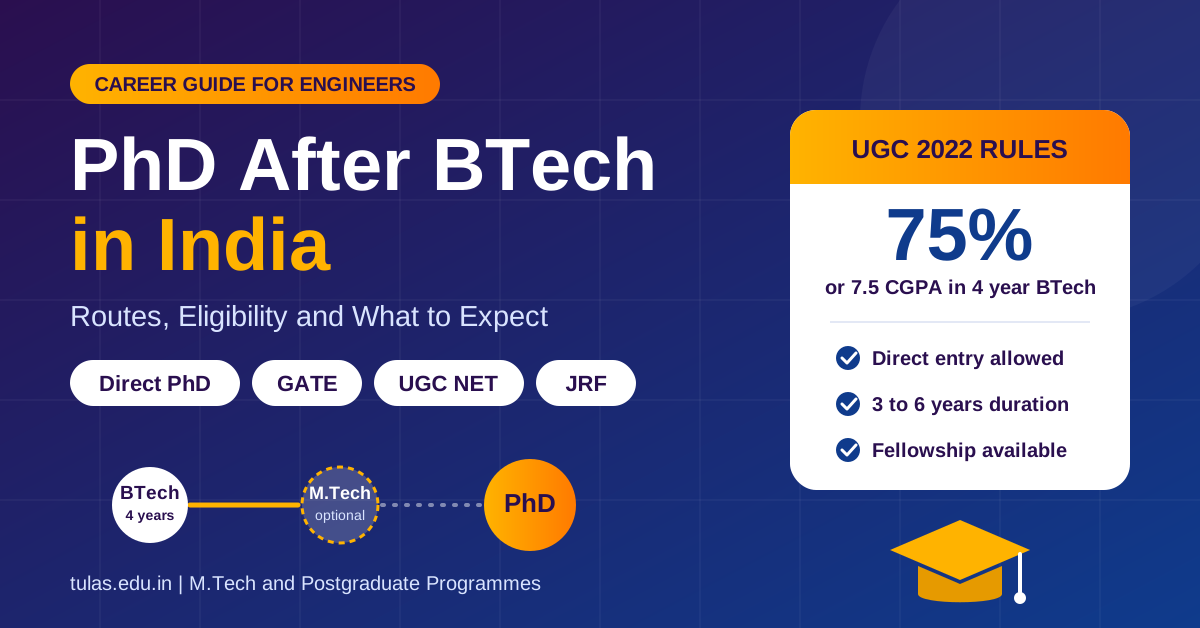
Yes. A PhD after BTech is allowed in India, and it has become easier to justify on paper since the UGC notified its 2022 regulations. Under those rules, a candidate with a four year bachelor's degree and at least 75 percent marks, or an equivalent grade such as 7.5 on a 10 point scale, can be considered for doctoral admission. BTech is a four year, eight semester programme, so it fits that clause in most cases.
Allowed and easy are different words, though. Seats are limited, supervisors choose their own scholars, and several universities still lean towards applicants who hold a master's degree or a national test score. So a direct PhD after BTech is real, but it is competitive and varies from one institute to the next.
Eligibility for a PhD After BTech Under UGC Rules
The UGC framework sets a minimum floor. Individual universities are free to raise it, which is why two applicants with identical marks can get different answers from different campuses.
Qualification before PhD
Minimum requirement
What it means for you
Four year BTech or BE
75 percent marks or 7.5 CGPA
Direct entry, subject to institute rules
One year master's after a four year bachelor's
55 percent marks or equivalent grade
Fits students who add a short master's year
Two year M.Tech or MSc after a three year bachelor's
55 percent marks or equivalent grade
The traditional route, accepted almost everywhere
MPhil earned before the rule change
Remains valid
MPhil was discontinued from the 2022 to 2023 academic year
Candidates from reserved categories and persons with disabilities get a relaxation of 5 percent marks, as per government norms. Universities may also admit scholars through their own entrance test and interview, in which case the candidate does not need a NET score. Always read the admission notice of the specific university before building a plan around any rule.
Direct PhD After BTech: Who Actually Gets Selected
Admission committees at IITs, IISc, NITs, IIITs and central universities usually look at four things: academic record, test score, research evidence and interview performance. Cut offs differ by department, but a CGPA of 8 or above together with a valid GATE score is a common starting point for funded seats.
Picture two applicants. The first has a 9.0 CGPA and no project beyond the syllabus. The second has 8.3, a final year project that grew into a conference paper, and a strong GATE rank. In most interviews, the second candidate sounds like a researcher, and that matters more than a decimal point.
If you are weighing a direct PhD after BTech, treat research evidence as your real currency. Internships in faculty labs, patents, open source contributions and published papers all count. A supervisor wants to know that you can survive four years of uncertainty, not just that you can score well in exams.
Four Ways to Reach a Doctorate From a BTech Degree
There is no single road. The table below compares the routes most students actually take.
Route
When PhD starts
Best suited for
Main catch
Direct admission after BTech
Right after graduation
High CGPA, clear research interest
Competitive, supervisor dependent
BTech, then M.Tech, then PhD
After two extra years
Students who want a stronger base
More time and cost
Job first, then part time PhD
After two to five years
Working professionals
Slower progress, needs employer support
Short master's year, then PhD
After one extra year
Those who need a bridge
Limited number of institutes offer it
Students who are unsure about research often prefer the second route. Those who already have a clear problem to solve, and a supervisor willing to guide them, can go straight in. A PhD after BTech does not have to start the week after graduation. Many strong scholars join after two or three years in industry, when their questions have become sharper.
Exams and Scores That Open the Door for a PhD After BTech
GATE is the most important test for engineers. A valid score helps secure funded seats at IITs, NITs, IIITs and many state universities, and it often carries fellowship benefits.
UGC NET is open to selected subjects, including Computer Science and Applications, and qualifies candidates for the junior research fellowship and for assistant professor eligibility. CSIR NET accepts BTech graduates in some science subjects, so check the current notification for your branch.
The junior research fellowship is the prize most applicants chase. At the time of writing, it stands at around ₹37,000 per month for the first two years, though the amount is revised from time to time, so verify it on the official notice. A national fellowship also gives you the freedom to choose a supervisor, not just a seat.
Some universities run their own entrance test and interview. For these, preparation looks different. You revise core subjects, read recent papers in your target area and practise explaining your project in plain language.
How to Do PhD After BTech: A Practical Roadmap
Here is the sequence that works for most applicants.
- Choose a research area first. Pick a field such as structural health monitoring, machine learning, thermal systems or embedded design before you pick an institute.
- Build proof of research. Turn your final year project into a paper, or join a faculty lab as an intern.
- Prepare for GATE or NET. Start at least eight months before the exam date.
- Shortlist eight to ten supervisors. Read their recent papers and send a short, specific email, not a mass message.
- Write a clear research proposal. Two pages with a problem, a gap and a method is enough.
- Prepare for the interview. Expect questions on fundamentals, your project and why you want a doctorate at all.
Notice that the roadmap for how to do PhD after BTech is about people and proof as much as paperwork. The applicant who has already spoken to a supervisor usually walks into the interview with an advantage.
Is an M.Tech First the Smarter Move?
For many students, yes. A master's degree gives time to specialise, publish and test whether research suits you. It also removes doubts about eligibility, because the two year master's route is accepted almost everywhere.
If you want a structured bridge, the M.Tech programme at Tulas University covers Civil, Computer Science and Mechanical Engineering and is AICTE approved. Compare the cost of the extra years on the Tulas fee structure page before you decide, since the master's years are an investment of both time and money.
Students coming from a BCA programme can follow a parallel path through the MCA programme before aiming for research. The honest trade off is time. A master's adds two years, and in some labs a direct PhD after BTech candidate with strong research output is preferred over an M.Tech holder with none.
Duration, Cost and Funding
Under the UGC framework, a doctoral programme runs for a minimum of three years and a maximum of six, with two extra years permitted for women and persons with disabilities. Coursework comes first, followed by a research proposal, periodic progress reviews and a thesis.
Item
What to expect
Duration
Three to six years
Coursework
Usually in the first year, with credits set by the institute
Fellowship
Around ₹37,000 monthly at the junior research fellowship level, subject to revision
Tuition
Low or waived for funded scholars at government institutes, higher at private universities
Publications
Decided by institute rules, no longer a universal requirement for submission
Self financed scholars planning a PhD after BTech at a private university should budget carefully. Checking the fee page of any institute before applying is a habit worth building, and the same goes for the Tulas fee structure page when you compare postgraduate options.
What Research Life Feels Like During a PhD After BTech
The first year feels like school again, with coursework, assignments and literature reviews. The second year is where it gets lonely. You stop receiving questions and start generating them. Experiments fail, simulations refuse to converge, and a reviewer may reject a paper you worked on for months.
Students who thrive usually share three habits. They write every week, they meet their supervisor with specific questions, and they build a small circle of peers for honest feedback. A supportive supervisor changes everything, which is why choosing a person matters more than choosing a famous name.
Expect a modest income compared with campus placement offers, flexible but long working hours, and a steady need to explain your work to relatives who ask when you will get a real job.
Careers and Pay Once the Doctorate Is Done
A doctorate opens doors that a BTech alone does not. Teaching posts at universities usually need a PhD or a NET qualification. Entry level assistant professor basic pay on the UGC and AICTE scale starts at Level 10 of the pay matrix, at roughly ₹57,700 per month before allowances.
Research roles at DRDO, ISRO, CSIR laboratories and corporate R&D centres also prefer doctorates. Fields such as machine learning, materials science and energy systems reward PhD holders with research scientist positions, often with international options.
Anyone choosing a PhD after BTech should also think about earnings. A friend who starts a job at 22 will have five or six years of salary growth before a scholar finishes the thesis. Whether that gap closes depends on field, location and individual outcomes.
Mistakes That Cost Applicants a Year
Applicants chasing a PhD after BTech tend to repeat the same errors.
Chasing brand names is the first. A supervisor who answers emails and publishes regularly is worth more than a famous campus with an absent guide.
Waiting for the fellowship to decide everything is the second. Some people spend a full year on repeated NET attempts while open seats at institutes with their own tests pass by.
Ignoring marks rules is the third. An applicant with 72 percent applies to an institute that expects 75 and discovers it at the document stage. Check percentage conversion early.
Sending generic emails is the fourth. Professors skip them. Mention a specific paper and a specific idea instead.
Frequently Asked Questions
Can I do PhD after BTech in India?
Yes. A candidate with a four year BTech and the required marks or CGPA can apply, subject to the admission rules of the specific institute. Some departments still prefer a master's degree or a GATE score, so read the notice first.
Can we do PhD after BTech without M.Tech?
Yes. The UGC framework allows direct admission after a four year bachelor's degree with at least 75 percent marks or 7.5 CGPA. Selection depends on the institute, the supervisor and the entrance process.
Can PhD be done after BTech without GATE?
Yes, at universities that run their own entrance test and interview. GATE helps with funded seats at central institutes, but it is not the only entry point.
Can I take PhD after BTech in a different subject?
Often yes, but you may need bridge courses. A move into management or public policy usually requires an entrance exam and some extra coursework.
How long is a direct PhD after BTech?
Usually three to six years, including coursework and thesis, based on UGC norms. Women and persons with disabilities get two additional years.
How to do PhD after BTech while working?
UGC regulations allow part time doctoral study for working professionals, usually with employer consent. Expect a longer timeline and strict attendance and progress review rules at your institute.
Your Research Journey Can Start This Semester
Whether your goal is a PhD after BTech or a master's first, the best moves happen early. Talk to a professor this week, turn your project into a paper, and shortlist three supervisors whose work excites you.
If you want a structured postgraduate step before research, explore the programmes at Tulas University and speak to the admissions team about M.Tech options that match your branch. Your doctorate does not begin on the day you get admission. It begins on the day you decide to ask a better question.