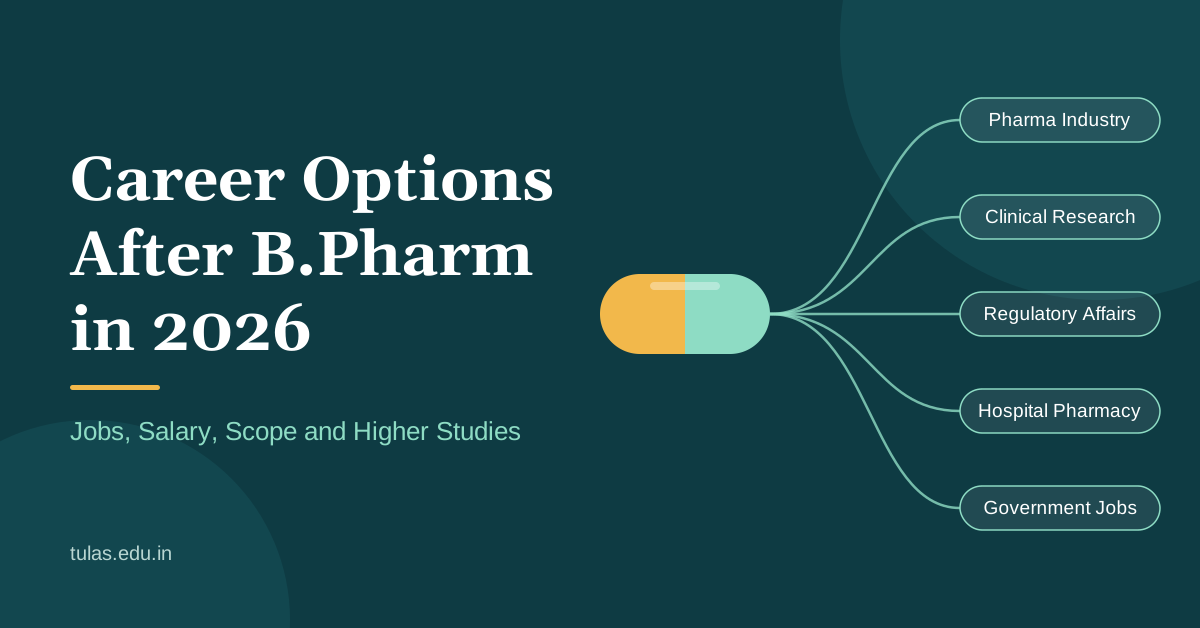
Career Options After B.Pharm in 2026: Jobs, Salary, Scope and Higher Studies
Wondering about job opportunities after B Pharm? This guide covers pharma, hospital, government and research careers, real salary ranges, higher studies and how to pick the right path in 2026.
Every year, thousands of B.Pharm graduates in India reach the same crossroad. The degree is in hand, the exams are over, and one question keeps coming back: what next? Some feel the pressure of low starting salaries they hear about from seniors. Others have not realised how wide the field has become.
Why a B.Pharm Degree Still Opens So Many Doors
India is one of the world's largest suppliers of generic medicines and vaccines. The country exports medicines to well over 200 markets, and the sector keeps adding roles in manufacturing, research, regulation and patient care.
A B.Pharm graduate is trained in drug chemistry, pharmaceutics, pharmacology and quality systems. That mix is rare. It lets you move between a factory floor, a hospital ward, a research lab and a regulatory desk.
If you are weighing the degree itself, the B.Pharm course at Tula's Institute [replace with your B.Pharm course URL] shows how the four year structure maps to these career paths.
Job Opportunities After B Pharm at a Glance
Before going deep, here is a quick map. Salary figures are approximate starting ranges for freshers in India and vary by city, company size and skills.
Job Role | Sector | Approx. Starting Salary (per year) | Growth Outlook |
|---|---|---|---|
Production Executive | Pharma manufacturing | 2.4 to 4 LPA | Steady |
Quality Assurance Executive | Pharma manufacturing | 2.5 to 4.5 LPA | Strong |
Quality Control Analyst | Pharma labs | 2.4 to 4 LPA | Steady |
Regulatory Affairs Associate | Pharma and biotech | 3.5 to 6 LPA | Very strong |
Clinical Research Associate | CRO and pharma | 3 to 5.5 LPA | Strong |
Pharmacovigilance Associate | CRO and pharma | 3 to 5 LPA | Strong |
Hospital Pharmacist | Healthcare | 2.4 to 4.5 LPA | Steady |
Medical Representative | Sales | 3 to 5 LPA plus incentives | Performance based |
Drug Inspector | Government | Pay as per state or central scale | Very stable |
Treat these as guides, not promises. A fresher in a metro with strong English and software skills can start above these figures, while a small town plant may pay less.
Pharma Industry Roles That Hire Freshers
Manufacturing and quality teams remain the largest recruiters of B.Pharm graduates. If you want a hands on role, this is the most direct entry point.
Production teams handle the actual making of tablets, capsules, syrups and injectables. The work is shift based, and the learning curve is steep in the first year.
Quality assurance and quality control are different. QA builds and audits systems, documentation and compliance. QC tests raw materials and finished products in the lab. Many seniors in the industry will tell you that QA offers a smoother climb into managerial roles because it teaches how audits and regulations really work.
Research and development roles exist too, but they usually prefer M.Pharm or PhD qualifications. A B.Pharm graduate can still enter as a formulation trainee and grow with further study.
Colleges with active industry tie ups often help here. When comparing institutions, check the placement record [replace with your placement page URL] and the type of companies that visit the campus.
Clinical Research and Pharmacovigilance Jobs
This is among the fastest growing pharmacy job opportunities in India. Global drug companies run trials across Indian cities, and contract research organisations need trained people to manage them.
A Clinical Research Associate monitors trial sites, checks data and ensures that patient safety rules are followed. A Pharmacovigilance Associate tracks and reports side effects of medicines once they reach the market.
Both roles are desk based, English heavy and well suited to graduates who like detail work. A short certification in clinical research or drug safety, which usually runs three to six months, often makes the difference between a rejected and a shortlisted CV.
Salaries begin modestly, but experienced professionals with five to eight years in the field commonly cross 10 LPA, and senior roles in multinational firms go well beyond that.
Regulatory Affairs: The Quiet High Earner
Regulatory affairs professionals prepare and submit the documents that get a medicine approved by authorities such as the CDSCO in India or the US FDA overseas. It is meticulous work, and companies pay well for people who do it accurately.
Freshers often enter through a regulatory trainee role or a diploma in regulatory affairs. The best job after B pharmacy for someone who enjoys documents, rules and structured thinking is often this one. Demand rises every time an Indian company expands into a new export market.
Hospital and Community Pharmacy
Not every graduate wants to work in a factory or a lab. Many prefer direct patient contact.
Hospital pharmacists manage the dispensing of medicines, check prescriptions for dangerous interactions and advise on dosage. Clinical pharmacy roles are expanding as hospitals recognise how much medication errors cost.
Community pharmacy is the other route. After registering with your State Pharmacy Council, you can work in a retail chain or open your own store. Online pharmacy platforms have also created roles in pharmacy operations, inventory and customer support.
Ownership carries risk but also freedom. A well located medical store with a licensed pharmacist can build steady income, though margins have tightened because of competition from large chains and digital platforms.
If you are still deciding between pathways, the D.Pharm course [replace with your D.Pharm URL] is also worth understanding, since many pharmacists begin there before upgrading to B.Pharm.
Government Jobs After B Pharm
Government jobs after B Pharm are popular for one reason: stability. Salaries follow pay commission structures, and benefits such as pension schemes, medical cover and allowances are attractive.
Common government routes include:
- Drug Inspector in state or central drug control departments, usually through a public service commission
- Pharmacist in government hospitals, AIIMS, ESIC and state health departments
- Pharmacist in the Indian Railways health services
- Pharmacist roles in the armed forces medical services
- Scientific and technical roles in research bodies such as CSIR labs, with further qualifications
Eligibility, age limits and exam patterns differ by state and recruiting body, so always check the official notification. Registration with the State Pharmacy Council is almost always required. Start preparing in your final year, because competition is tight and vacancies come in waves.
A drug inspector, for example, typically needs a B.Pharm or equivalent degree and holds real regulatory authority over manufacturers and retailers. It is demanding but respected work.
Sales, Marketing and Medical Representative Careers
Medical representatives connect pharma companies with doctors and chemists. The base pay is modest, but incentives can lift annual earnings sharply for strong performers.
This path suits communicative, mobile and target driven people. A B.Pharm degree gives you credibility because you actually understand the product you are explaining. Many successful pharma marketing managers began as medical representatives and then moved into product management after an MBA.
How to Choose the Best Job After B Pharmacy
There is no single winner. The best job after B pharmacy depends on temperament, finances and long term goals. Here is a simple comparison to help.
If You Are | Consider | Why |
|---|---|---|
Detail oriented and calm | Regulatory affairs, QA, pharmacovigilance | Document heavy, compliance driven |
Hands on and technical | Production, QC, formulation | Direct involvement in making medicines |
People focused | Hospital pharmacy, clinical pharmacy | Patient interaction every day |
Ambitious about stability | Government pharmacist, drug inspector | Security, pension and respect |
Sales minded and outgoing | Medical representative, marketing | Incentive led income |
Academic or research minded | M.Pharm, PhD, R&D | Deeper specialisation |
A useful test is to ask yourself where you want to be in five years, not next month. Someone who wants an international career should lean toward regulatory affairs or clinical research. Someone who wants to run a business should consider community pharmacy or pharmaceutical distribution.
Higher Studies After B.Pharm: Is It Worth It?
For many students, the smartest move is not a job but another degree. Here are the main options.
Option | Duration | Best For |
|---|---|---|
M.Pharm | 2 years | Research, teaching, specialised R&D roles |
MBA in Pharma Management or Healthcare | 2 years | Marketing, operations, leadership roles |
Pharm.D (Post Baccalaureate) | 3 years | Clinical practice and hospital roles |
MS or MSc abroad | 1 to 2 years | International research and industry careers |
MPH (Public Health) | 2 years | Public health and policy |
PhD | 3 to 5 years | Scientist, professor, deep research |
GPAT is the national entrance exam for M.Pharm admission and for AICTE scholarships for qualifying students. Even if you plan to work first, preparing for GPAT keeps the door open. If you want to explore options, compare the M.Pharm programme [replace with your M.Pharm URL] and the B.Pharm fee structure and admission details to understand costs before committing.
A word of honest advice: M.Pharm adds real value if you want R&D, teaching or senior scientist positions. For production, QA or sales, experience often beats an extra degree, so weigh time and money carefully. If you are applying anywhere, review the admission process [replace with your admission page URL] early so deadlines do not catch you off guard.
Working Abroad With a B.Pharm Degree
Countries such as the USA, UK, Canada, Australia and Germany recognise pharmacy training, but you cannot simply start practising as a pharmacist. Each country has its own licensing exams. For example, Indian graduates usually need to clear the FPGEE for the US or the OSPAP route for the UK.
Many graduates go abroad for a master's degree in pharmaceutical sciences, regulatory affairs or clinical research, then enter industry roles on a post study work visa. It is a longer road, but the salary difference can be significant.
Skills That Raise Your Salary Faster
Degrees get interviews, but skills get raises. Across every pharmacy career path, a few abilities consistently separate high earners from the rest.
Clear written English matters in regulatory, clinical and quality roles. Basic data skills in Excel or SQL help in pharmacovigilance and clinical data management. Knowledge of Good Manufacturing Practice, Good Laboratory Practice and Good Clinical Practice is a strong advantage in industry hiring.
Hands on lab exposure counts too. Look at the campus facilities [replace with your labs or facilities page URL] of any college you consider, because well equipped labs build confidence that interviewers can actually see.
Mistakes Freshers Make After B Pharm
Some errors repeat year after year. Accepting the first offer without checking the role is the most common. A job titled executive can mean anything from desk work to night shift on a packing line.
Another is ignoring registration. Without State Pharmacy Council registration, many pharmacist roles and all government pharmacist posts stay out of reach.
A third is waiting too long. Students who pause for a year with no plan often find their knowledge fading and their confidence dropping. Even a short certification, an internship or a GPAT attempt keeps momentum alive.
What Does the Scope of B Pharm Look Like Beyond 2026?
The outlook is positive. An ageing population, rising chronic disease, growth in biosimilars, and the push for domestic manufacturing under government schemes all create demand. Fields like pharmacovigilance, clinical research and regulatory affairs are expected to keep growing faster than traditional roles.
The graduates who will benefit most are those who pair their degree with a specialisation. Generic knowledge gets average pay. Specific skills in a growing niche get noticed.
Frequently Asked Questions
Which job is best after B.Pharm?
There is no single best job. Regulatory affairs, clinical research and quality assurance offer strong growth, while government pharmacist and drug inspector roles offer stability. Pick based on your skills and goals.
What is the salary of a B.Pharm fresher in India?
Most freshers start between 2.4 and 5 LPA, depending on role, city and company. Regulatory affairs and clinical research roles often pay at the higher end.
Can I get a government job after B.Pharm?
Yes. You can apply for pharmacist posts in government hospitals, ESIC and railways, and for drug inspector roles through public service commissions. State Pharmacy Council registration is required.
Is B.Pharm a good career in 2026?
Yes. India's pharmaceutical industry continues to expand, and demand is rising for skilled people in manufacturing, research, regulation and patient care.
Should I do M.Pharm or take a job after B.Pharm?
Choose M.Pharm if you want research, teaching or senior R&D roles. Choose a job if you want industry experience and income sooner. Many students work first and study later.
Are there jobs after B.Pharm without GPAT?
Yes. Production, QA, QC, pharmacovigilance, clinical research, hospital pharmacy and sales roles do not require GPAT.
Ready to Build Your Pharmacy Career?
Your degree is only the starting line. The choices you make in the next six months, whether that is a certification, a GPAT attempt, a government exam or a first job, will shape the next decade.
If you are still looking for the right place to study pharmacy, take a closer look at Tula's Institute, check the B.Pharm fee structure and contact the admission team [replace with your contact page URL] to ask about courses, labs and placement support. Take that first step today, and give your pharmacy career the direction it deserves.