CLAT 2027 Exam Date, Syllabus, Pattern and Eligibility: Complete Guide
CLAT 2027 is on 6 December 2026. Get the exam date, section wise syllabus, pattern, eligibility, a last 11 days plan and law admission options without CLAT.
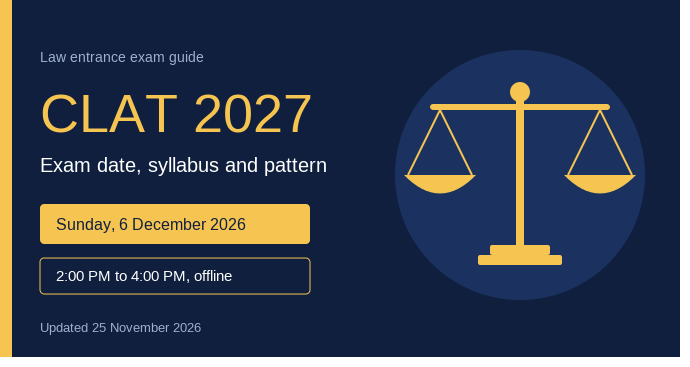
The CLAT 2027 exam date is Sunday, 6 December 2026, and the paper runs from 2:00 PM to 4:00 PM. It is a pen and paper test, so you will mark answers on an OMR sheet at your allotted centre. Registration has closed. With only 11 days left, your job now is revision, mock tests and a calm plan for exam day. Every date and rule here follows the Consortium of National Law Universities, the body that conducts the test.
CLAT 2027 quick facts
Detail | Information |
|---|---|
Exam name | Common Law Admission Test (CLAT) 2027, UG |
Conducting body | Consortium of National Law Universities |
Exam date | Sunday, 6 December 2026 |
Time | 2:00 PM to 4:00 PM (120 minutes) |
Mode | Offline, pen and paper (OMR sheet) |
Number of questions | 120 objective (MCQ) questions |
Total marks | 120 |
Marking scheme | Plus 1 for a correct answer, minus 0.25 for a wrong answer, no penalty if unattempted |
Registration status | Closed (last date was 31 October 2026) |
Key dates for the CLAT 2027 exam date cycle
Event | Date |
|---|---|
Notification released | 22 July 2026 |
Registration opened | 3 August 2026 |
Last date to apply | 31 October 2026 |
Admit card | About two weeks before the exam |
CLAT 2027 exam date | 6 December 2026 |
Provisional answer key | Shortly after the exam (expected) |
Result | Third week of December 2026 (expected) |
The reported closing date was 31 October. A few websites mention a short extension to 7 November, so check the official portal for the final word. The admit card timing follows earlier years, which means it should already be available in your login. If you have not downloaded it yet, do it today.
Has the CLAT 2027 syllabus changed?
No. The Consortium has confirmed that there is no change in the UG and PG syllabus or exam pattern for 2027. If your preparation material was built for the 2026 paper, you can keep using it.
That is good news, but it does not make the paper easy. Every section is built around passages, which means reading speed decides how many questions you can attempt with care. Most students who struggle do not lack knowledge. They run out of time on long passages.
CLAT 2027 syllabus section by section
The paper has five sections. The ranges below follow the pattern the Consortium has used in recent papers, and the pattern is unchanged for 2027. Match them against the official notification before you finalise your plan.
Section | Questions | Weightage | What it tests |
|---|---|---|---|
English Language | 22 to 26 | 20% | Comprehension, inference, vocabulary in context |
Current Affairs including General Knowledge | 28 to 32 | 25% | Recent events, international affairs, arts, static facts |
Legal Reasoning | 28 to 32 | 25% | Applying legal principles to given facts |
Logical Reasoning | 22 to 26 | 20% | Arguments, premises, conclusions, analogies |
Quantitative Techniques | 10 to 14 | 10% | Data in graphs and tables, maths up to Class 10 |
English Language
Expect passages from fiction and nonfiction on contemporary and historical subjects. Questions ask about meaning, tone, inference and the use of words in context. Grammar rules are not tested in isolation, but strong writing sense helps you read faster.
Current Affairs including General Knowledge
These questions come from passages based on newspapers and other sources. Focus on recent months, international developments, major judgments, awards, and arts and culture. Static facts such as constitutional bodies and historical events appear too, but the weight leans toward the present.
Legal Reasoning
You get a passage that explains a rule or principle, followed by a set of facts. Your task is to apply the rule exactly as written, even if you disagree with it. No prior legal knowledge is required, though basic familiarity with the Constitution, contracts, torts and criminal law makes passages feel less strange.
Logical Reasoning
Think of short arguments where you must find the conclusion, spot the weak link, strengthen or weaken a claim, or draw an inference. Analogies and pattern questions also appear. Slow, careful reading beats speed here.
Quantitative Techniques
This is the smallest section, but it is also where marks are easiest to lose or gain. Questions use tables, charts and short numerical passages. Ratios, percentages, averages and basic algebra cover most of what you will see.
How the exam pattern works in practice
You get 120 minutes for 120 questions, so the average is one minute per question. That sounds fair until you meet a 450 word passage with five questions attached. Some sections will run long and others short, which means you need a time plan before you walk in.
Negative marking works against random guessing, but only just. With four options, a blind guess has an expected value of about plus 0.06 marks. Once you can remove even one option, guessing becomes a sensible bet. A wild guess with no reasoning is not worth the stress.
Here is a time split many mentors suggest. It is a suggestion, not an official rule, so adjust it after your next mock.
Section | Suggested minutes |
|---|---|
English Language | 25 |
Current Affairs including General Knowledge | 25 |
Legal Reasoning | 35 |
Logical Reasoning | 25 |
Quantitative Techniques | 10 |
Start with the section that gives you the highest accuracy, and leave Legal Reasoning for when your mind is warm. Whatever order you choose, practise it in your remaining mocks so it feels natural on 6 December.
Who can appear: CLAT 2027 UG eligibility
Candidates need a Class 12 pass or equivalent. Recent Consortium notifications have asked for at least 45 percent marks for General, OBC, PwD, NRI, PIO and OCI candidates, and 40 percent for SC and ST candidates. They have also had no upper age limit. Students appearing in their Class 12 board exams in 2027 have been allowed to apply, with proof of passing to follow. Read the 2027 brochure on the Consortium website for the exact wording, since rules can shift between cycles.
Admit card and exam day checklist
Log in to the Consortium portal with your registration details, download the admit card and print a clear copy. Check your name, photograph, centre address and reporting time. If anything is wrong, raise it with the Consortium helpdesk immediately.
On the day, keep this short list ready:
- A printed admit card.
- The photo identity proof listed on your admit card.
- Ballpoint pens as required for the OMR sheet.
- A plan to reach the centre early, ideally after a visit the day before.
Leave phones, smart watches and other electronic items behind, since the instructions on your admit card will specify what is not allowed.
Your plan for the last 11 days
Dates | Focus |
|---|---|
25 to 27 November | Take two full length mocks and note every mistake in a notebook |
28 to 30 November | Sectional drills, with extra time on your weakest two sections |
1 to 3 December | One mock a day at 2:00 PM, which matches your real exam slot |
4 December | Light revision of notes, formulas and legal principles |
5 December | Rest, check your admit card, confirm travel, sleep early |
6 December | Exam day |
Notice that the plan gets lighter near the end. Learning new topics in the last two days rarely helps and often adds panic. Trust the work you have already done.
Habits that help more than extra hours
Read one editorial and one long passage every day. Do not just read them. Summarise each in two lines, then check your summary against the text. This trains the exact skill the paper rewards.
After every mock, spend more time on the review than on the test itself. Sort mistakes into three types: did not know, misread, and ran out of time. Each type needs a different fix, and the pattern tells you more than your score does.
For current affairs, make a single page per week with the major events, then revise those pages daily. A smaller set of notes you actually revisit beats a large pile you never open.
Law admission without CLAT: your options
CLAT is the most visible route into law, but it is not the only one. Many students find a better fit through other doors, especially if a particular score is out of reach this year.
Route | Who uses it | Things to know |
|---|---|---|
CLAT | Consortium member NLUs and several other colleges | One national test each year |
AILET | NLU Delhi | A separate test, not CLAT |
LSAT India | Several private law schools | Check which colleges accept it |
SLAT | Symbiosis law schools | Institution specific test |
State level law tests | Colleges within that state | Eligibility differs by state |
Marks based admission | Many private universities | Based on Class 12 results, so check each college |
Before you pick a college, check approval and standards. The Bar Council of India regulates legal education, and a law degree should meet its norms if you plan to practise. Our guide on how to choose the best university for LLB in India walks through the questions worth asking, from faculty and moot courts to internships and placements. If you want a human answer, you can also speak to the admissions team.
Law programmes at Tulas University
Tulas University offers three law programmes through its School of Law.
Programme | Route | Suited to |
|---|---|---|
LL.B. (3 years) | After graduation | Graduates moving into law |
BA LL.B. | Integrated, after Class 12 | Students with an interest in humanities and policy |
BBA LL.B. | Integrated, after Class 12 | Students drawn to business and corporate law |
The LLB programme page lists marks based eligibility and does not mention CLAT. That makes it a practical option for students who want to secure a law seat without waiting for CLAT results. Admission rules can change by year, so confirm the current process with the admissions team before you apply. You can also review the fee structure to plan costs early.
What happens after 6 December
Once the exam is over, expect a provisional answer key, a window to raise objections, the final answer key and then the result. Counselling for participating colleges follows. We will update this page with the answer key and result as soon as the Consortium publishes them, so bookmark it.
Frequently asked questions
What is the CLAT 2027 exam date?
The CLAT 2027 exam date is Sunday, 6 December 2026. The paper will be held from 2:00 PM to 4:00 PM in offline mode, with 120 objective questions to be solved in 120 minutes. Reach your centre well before the reporting time printed on your admit card.
Is CLAT 2027 registration still open?
No, registration is closed. The reported last date to apply was 31 October 2026, and a few sources mention a short extension. Check the Consortium website for any official notice, and keep other law admission routes in mind if you missed the window.
Has the CLAT 2027 syllabus changed?
No. The Consortium has confirmed that the UG and PG syllabus and exam pattern for 2027 remain the same as before. You can continue with your existing preparation material, but confirm section details against the official notification on the Consortium website.
What subjects are in the CLAT 2027 syllabus?
The CLAT 2027 syllabus has five sections: English Language, Current Affairs including General Knowledge, Legal Reasoning, Logical Reasoning and Quantitative Techniques. Each section is passage based, so reading comprehension underpins the entire paper. Quantitative Techniques carries the lowest weightage, at about 10 percent.
What is the CLAT 2027 exam pattern?
CLAT 2027 is an offline test with 120 objective questions for 120 marks in 120 minutes. Each correct answer earns one mark, and each wrong answer costs 0.25 marks. Unattempted questions carry no penalty. Confirm the marking details in the official notification before exam day.
When will the CLAT 2027 admit card be released?
The admit card is usually released about two weeks before the exam, so it should be available now. Log in to the Consortium portal with your registration details, download it and print a clear copy. Check your name, photograph, centre and reporting time, and report any mismatch immediately.
What is the difference between CLAT UG and CLAT PG?
CLAT UG is the entrance test for five year integrated law programmes after Class 12. CLAT PG is for the LLM programme after a law degree. The two tests have different eligibility rules and syllabus focus, so read the notification that applies to you.
What is the eligibility for CLAT 2027 UG?
For CLAT UG, candidates need a Class 12 pass or equivalent with the minimum percentage set by the Consortium, and recent notifications have not set an upper age limit. Because rules can differ by category, read the official 2027 brochure for the exact marks requirement.
Can I get law admission without CLAT?
Yes. Many private universities admit students through their own tests, other national exams or Class 12 marks. Tulas University lists marks based eligibility on its LLB page. Entry rules can change by year, so confirm the current admission process with the admissions team before applying.
Which law programmes does Tulas University offer?
Tulas University offers the LL.B. as a three year programme, along with the integrated BA LL.B. and BBA LL.B. courses. You can read the details on the official LLB page and compare costs on the fee structure page before speaking with the admissions team.
Ready to plan your law career?
Whether you sit for CLAT on 6 December or want a marks based route into law, a clear plan beats waiting. Apply Now or talk to our admissions team at Tulas University to find the programme that fits you.