
Why Learning AI Isn't Just for CSE Students Anymore
AI is no longer confined to Computer Science — Mechanical, Civil, Electrical, and Electronics engineers now need AI skills too. Here's why, how each branch is using it, and how Tulas University is preparing students through AI-integrated labs and projects.
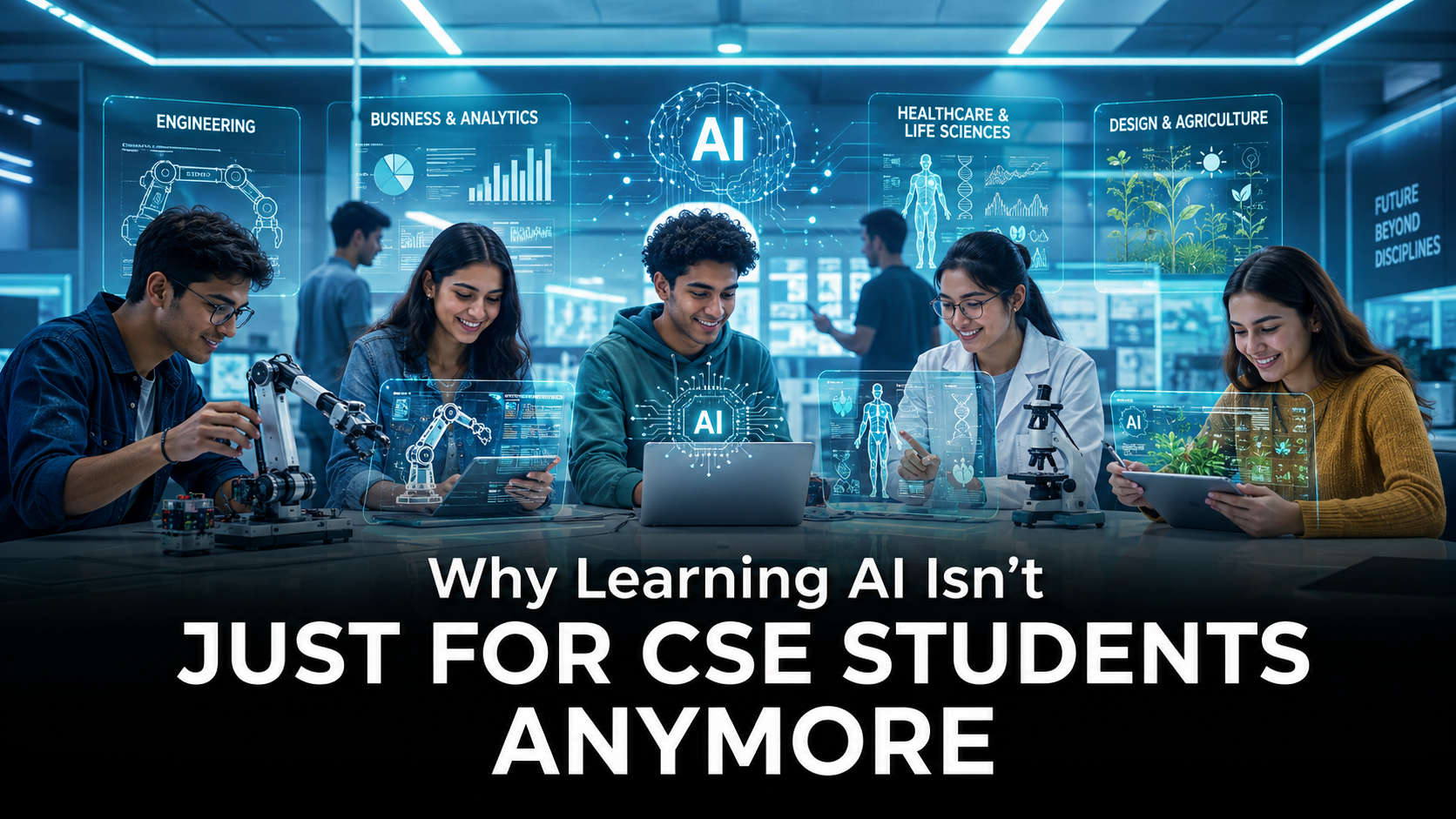
Artificial intelligence (AI) is now beyond Computer Science classrooms. It is transforming most of the engineering disciplines, including Mechanical, Civil, Electronics, Electrical, and many more. Industries are adopting smarter technologies, so engineering graduates are now expected to understand how AI works and how to implement it in their own field.
Do Mechanical and Civil Engineers Need to Learn AI in 2026?
Yes, AI is becoming a core skill that is not just for Computer Science, but also for other engineering fields like Mechanical and Civil. Let’s discuss the reasons why mechanical and civil engineers need to learn AI in 2026:
Mechanical engineers use AI for predictive maintenance, smart manufacturing, and robotics.
Civil engineers use AI for traffic planning, structural health monitoring, and construction management.
Learning AI is equally important for Electrical and Electronics engineers so that they can effectively use AI in smart grids, automation, and embedded systems.
At Tulas University, AI concepts are blended with practical learning through industry-focused projects and advanced labs.
Why AI Is No Longer Just a Computer Science Branch
A few years ago, AI used to be mostly associated with software development. Today, it is improving transportation systems, manufacturing plants, renewable energy, construction projects, industrial automation, and healthcare devices.
Nowadays, modern engineers are expected to combine domain knowledge with AI-driven tools to solve complex real-world problems more accurately and faster.
This is one of the main reasons why companies now consider engineers who can work with AI regardless of their specialization.
How AI Is Used Across Engineering Branches
AI is now creating opportunities across every engineering discipline. Check out the tabular explanation below to understand how AI is used across various engineering branches:
Engineering Branch | How AI Is Used | Real-World Example |
Mechanical Engineering | Robotics, smart manufacturing, predictive maintenance | AI predicts machine failures before breakdowns |
Civil Engineering | Traffic management, structural health monitoring | AI identifies cracks and predicts bridge maintenance |
Electrical Engineering | Energy optimization, smart grids | AI manages and balances electricity demand and supply |
Electronics & Electronics Engineering | Embedded AI, automation, IoT | AI-powered smart home and industrial automation systems. |
How AI is Changing Mechanical Engineering
Traditional manufacturing is rapidly becoming “smart manufacturing”. Engineers are now working with:
AI-powered quality inspection
Industrial robots
Predictive maintenance systems
Digital twins
Autonomous production lines
This means Mechanical Engineers who understand AI are better prepared and more relevant for Industry 4.0 workplaces.
Let’s Check Out How Civil Engineering Is Becoming Smarter
Civil engineers are increasingly depending on AI to enhance efficiency, safety, and infrastructure management. Some applications include:
Traffic flow optimization
Predictive structural maintenance for buildings and bridges
Construction scheduling
Smart city planning
Risk analysis for infrastructure projects
AI can analyze data from sensors installed on buildings and bridges to find early signs of structural damage. Then, professionals can perform maintenance before serious failures occur. They can improve public safety and reduce repair costs.
Will AI Take Core Engineering Jobs?
This is one of the biggest concerns among aspiring engineers. The answer is no. AI is made to automate repetitive tasks, instead of replacing engineering expertise. The only change you will see is that employers now expect a slightly different skill set. For them, an engineer who understands AI can:
Enhance system efficiency
Make faster decisions using data
Work alongside advanced machines
Solve complex engineering problems
Offer better project outcomes
In short, AI won’t replace you in your engineering career. Engineers who use AI will replace engineers who don’t.
How Does Tulas University Integrate AI Across Engineering Programs?
At Tulas University, AI learning is not beyond Computer Science students. Here, students work on projects that combine their core engineering knowledge with automation, AI, and intelligent systems.
Facility | How Students Use It | Skills Developed |
Maker Space | Develop prototypes and IoT devices | Rapid Prototyping, Innovation, Product Design |
Robotic Lab | Build automation projects and autonomous robots | AI, Robotics, Embedded Systems, Sensors |
Industry Projects | Solve practical engineering problems using AI | Practical exposure, Teamwork, Project Experience |
AI-Integrated Curriculum | Implement AI concepts in core engineering subjects | Data Analysis, Problem Solving, Industry Readiness |
Why Engineer With AI Skills Stand Out Among All
Various industries, including construction, manufacturing, energy, automotive, and infrastructure, are now looking for graduates who can bring both engineering fundamentals and emerging technologies. Engineers proficient with AI skills can contribute to:
Autonomous systems
Smart factories
Renewable energy optimization
Intelligent infrastructure
Data-driven engineering decisions
Industrial automation
These skills can boost your chances to secure a promising job across both core engineering companies and technology-driven industries.
What is the Future of Core Engineering Jobs With AI?
It’s a myth that engineering careers are disappearing. Instead, opportunities are evolving with time.
Core engineering is important, but engineers are now increasingly expected to work with AI-powered tools to enhance accuracy, productivity, and innovation.
If you understand both engineering discipline and AI, you will be a step ahead of those who don’t. This is because industries continue to adopt digital technologies.
At Tulas University, students are prepared for this future through practical labs, AI-integrated curriculum, project-based learning, and exposure to emerging technologies. This perfectly bridges the gap between theoretical learning and industry requirements.
Conclusion
AI is no longer an optional skill that is reserved for Computer Science students. Whether you opt for Civil, Mechanical, Electronics, Electrical, or another engineering branch, AI has become an important part of modern engineering careers.
Tulas University helps students to develop skills that are needed for the next generation of engineering jobs. The university combines strong engineering fundamentals with practical exposure through facilities such as Maker Space and Robotic Lab.
Frequently Asked Questions
Do Mechanical and Civil engineers need to learn AI in 2026?
Yes, AI has now become a crucial skill for Mechanical, Civil, and other engineering branches. It helps engineers to improve automation, design, decision-making, and automation.
How AI is changing Mechanical engineering?
AI is changing Mechanical engineering by enabling predictive maintenance, industrial robotics, smart manufacturing, automated production systems, and quality inspection. This makes manufacturing more reliable and efficient.
Is AI integrated into the BTech curriculum in India?
Many universities are introducing AI integrated curriculum BTech India. For example, Tulas University gives exposure to AI through practical labs, interdisciplinary projects, Maker Space, and Robotic Lab.
Will AI replace core engineering jobs in the future?
No, AI will not replace engineers. If the engineer understands AI, they will have a significant advantage in future job markets and modern industries.
Why is AI important for non-CS engineering branches?
AI helps engineers to automate procedures, analyze data, enhance efficiency, and solve complex engineering problems. This makes AI an important skill across modern engineering industries.
Can Mechanical, ECE, Civil, and EEE students at Tulas University work on AI-based projects?
Yes, students from Mechanical, Civil, ECE, and EEE can apply AI concepts through interdisciplinary projects, robotics, automation systems, and IoT-based applications.
Which Tulas University facilities help students learn AI practically?
Students get hands-on AI experience through the Robotic Labs, Maker Space, industry projects, and an AI-integrated curriculum. This encourages practical problem-solving across engineering disciplines.
.png)