How to Choose the Right BTech CSE Specialisation? A Complete Guide to Selecting the Best Branch for Your Skills, Interests and Career Goals
Choosing a BTech CSE specialisation shapes your first job more than most students realise. This guide compares the main tracks, shows how to test your interest, and explains how to match a branch to your skills and career goals.
Every year, thousands of students reach the same confusing page of an engineering brochure. The list of BTech CSE specialisations runs long: artificial intelligence and machine learning, cyber security, data science, cloud computing, Internet of Things, and a few names that sound like they were invented last week. Most students pick one based on a friend's advice, a senior's suggestion, or whichever option sounds most modern. That is a costly way to choose a four year path.
If you searched for a CSE specialization courses list in BTech, the table in the next section gives you that list in one place, with a plain English note on what each track teaches.
What a CSE specialisation actually means
Colleges use the word loosely, so start by clearing up the confusion. In some institutions, a specialisation is a separate programme with its own name on the degree, such as Computer Science and Engineering in AI and Machine Learning. In others, it is a track of electives inside the core CSE degree, and the certificate simply says Computer Science and Engineering. The difference matters. A named specialisation tends to signal focus to recruiters, while a track signals flexibility.
Before you compare colleges, read the sample degree certificate on each website. Ask whether the specialisation will be printed on your marksheet and degree. That single detail can change how an employer reads your profile during shortlisting.
The main types of CSE branches you will see
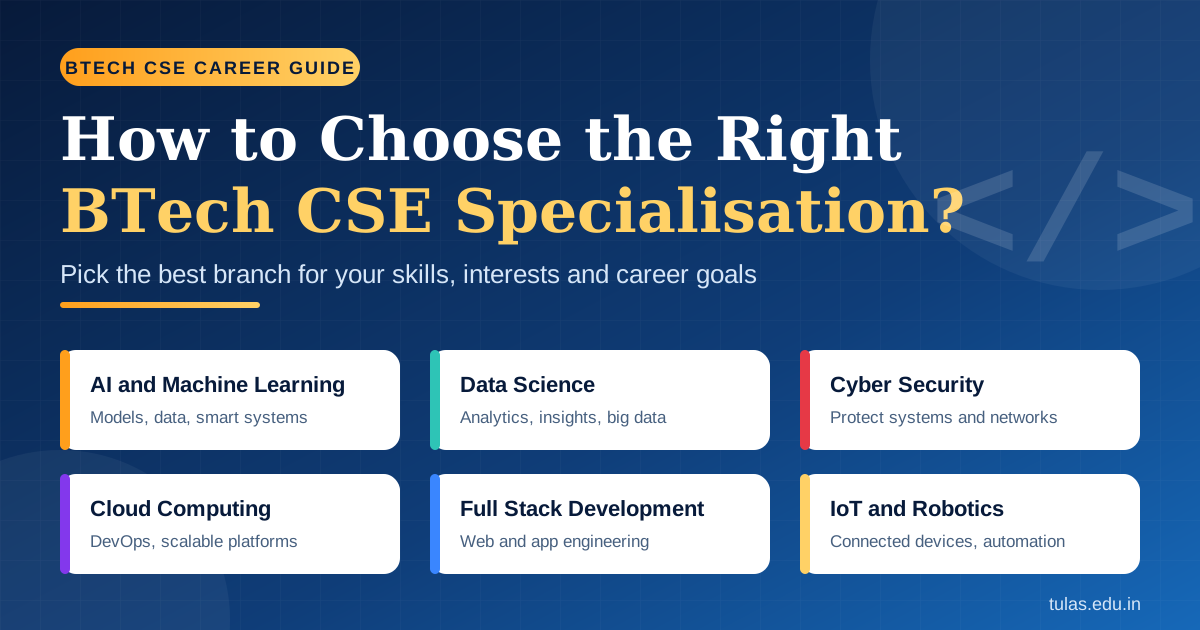
Most BTech CSE programmes in India group their specialisations into a handful of families. The table below compares six of the most common ones. Use it as a starting map, not as a verdict.
Specialisation | Core Focus | Typical Skills | Best Suited For |
|---|---|---|---|
Core CSE | Fundamentals of computing | Data structures, operating systems, databases, networks, Java or C++ | Students who want to keep options open |
AI and ML | Learning systems and prediction | Python, statistics, linear algebra, TensorFlow or PyTorch | Learners comfortable with maths |
Data Science | Extracting insight from data | Python or R, SQL, statistics, visualisation | Analytical and curious minds |
Cyber Security | Protecting systems and data | Networking, Linux, security tools, cryptography basics | Detail-oriented problem solvers |
Cloud Computing | Building and running infrastructure | AWS, Azure or Google Cloud, DevOps tools, containers | People who enjoy large systems |
Full Stack Development | Building complete web applications | JavaScript, databases, APIs, frameworks | Builders who like visible products |
Each row can branch further. A cloud track may lead toward DevOps and site reliability work, while an AI track may lead toward computer vision, natural language processing, or robotics. Ask the college which electives are offered in the third and fourth years, because the names on a brochure rarely tell the full story.
Tulas University currently lists four B.Tech CSE specialisations on its programmes page: AI and Machine Learning, Cyber Security, Data Science and Full Stack Development. Compare those four first, then look at other colleges if you want cloud or IoT.
Start with your interests, then test them
Interest is easy to claim and hard to verify. Many students say they love AI because a film made it look exciting, then discover that the mathematics bores them after three weeks. A better approach is to test your curiosity with small, low cost tasks before you decide.
Test | What It Reveals | Time Needed |
|---|---|---|
Write a short Python script for a daily task | Comfort with logic and syntax | One weekend |
Solve 20 easy and medium problems on a coding platform | Patience with problem solving | Two weeks |
Take a basic statistics course | Enjoyment of numbers and patterns | Four weeks |
Set up Linux on a spare laptop and manage it | Interest in systems and settings | One month |
Read a public data breach report and summarise it | Attention to security details | One evening |
Keep a simple log during the test. Write down what you enjoyed, what frustrated you, and whether you wanted to continue after the work was done. Enjoying the first two weeks of a course is not the same as enjoying three years of it, but the pattern in your notes will show what you naturally return to.
Match your existing skills to the branch
Skills matter more than labels. A student comfortable with probability and linear algebra will find machine learning far less painful than someone who struggled through calculus and avoided maths in school. Someone who enjoys reading documentation, tinkering with server settings, and fixing things that break may find cloud computing or cyber security more natural. Neither profile is weaker. They simply point toward different corners of the field.
Be honest about where you stand today. If you have never written more than a few dozen lines of code, do not assume the advanced tracks are closed to you. Most first year students begin from the same point, and the core syllabus is usually shared before any specialisation begins. What matters more is whether you are willing to practise daily once coursework starts.
There is also a trade-off to weigh. A narrow specialisation can make your résumé stand out in a specific hiring round, but it can also limit the roles you are considered for if the market shifts. A broader track keeps more doors open, while a focused track gives you a sharper story to tell interviewers. Decide which risk you are more comfortable carrying.
Look at the career path, not only the job title
Job titles change faster than most students expect. A role called data analyst a few years ago may now involve machine learning pipelines, and a security analyst role may depend heavily on cloud configuration. Instead of focusing on titles, look at the work itself. Ask what problems you would solve on a normal day, which tools you would use, and what a typical project looks like in the first two years after graduation.
Demand signals help too. NASSCOM has repeatedly highlighted growing demand for AI, data and cloud skills across Indian technology services and product companies. Government programmes such as Skill India have pushed short courses in emerging technologies, so students who build these skills early often reach placement season with a clear advantage. Choose a specialisation that connects to skills employers already name in their job descriptions.
What placements really depend on
Placement outcomes depend on several factors at once: the college, its recruiter network, your project portfolio, and your internships. A mid tier private institution with strong industry partnerships can outperform a well known name with weak connections. The specialisation label helps, but it rarely decides the result alone.
Before you choose, check the placement highlights at Tulas University and ask the placement cell for batch wise data rather than a single headline package. The questions below will give you a clearer picture than any brochure.
Question for the Placement Office | Why It Matters |
|---|---|
Which companies recruited in the last two batches? | Shows real and recent industry demand |
What is the role split by specialisation? | Reveals whether AI students actually get AI roles |
How many internships converted into offers? | Indicates practical exposure during the programme |
What are the median and average packages? | The median shows what an ordinary student can expect |
Do not chase the highest package on the brochure. Top offers are rarely typical, and a median figure tells you far more about your likely outcome.
Check the curriculum before you commit
Two colleges can sell the same specialisation name with very different syllabi. Download the course structure for the third and fourth year and read it line by line. You can get the Tulas University brochure for a start. Count the practical labs, the number of capstone projects, and the tools students actually use. A strong curriculum names its tools clearly, such as Python libraries, cloud platforms, security labs or hardware kits. A weak one lists broad topics with no lab component at all.
Check the faculty profiles as well. Teachers with industry experience or active research often bring real examples into class, and that difference shows up in the quality of the projects you can build.
Consider the cost and the time
Fees for BTech programmes vary widely between government and private institutions, and the gap can run into lakhs of rupees over four years. A specialisation does not always carry its own fee, but some colleges add charges for labs, software licences or certifications. Compare the total four year cost, not just the first year figure. Review the fee structure for B.Tech programmes to see how the charges are laid out year by year, and ask the admissions office whether any specialisation carries an extra fee.
Common mistakes students make
The most common mistake is picking the trendiest name without reading the syllabus. A close second is choosing based on a friend's success, forgetting that the friend's strengths, schedule and access to resources may differ from yours. Some students switch late in the programme and lose a semester of practice. Others avoid the decision entirely and stay in core CSE for four years, which can be a sensible path if they keep building skills in areas they care about.
Ask yourself which of these mistakes you are most likely to make. Then build a small safeguard against it, such as a personal rule that you will read two syllabi before comparing any brochure. For more practical reading, browse the Tulas University blog.
How to choose CSE specialisation in five steps
The decision becomes easier when you break it into stages. Work through the steps in order, and keep notes at each one.
Step | What You Do | What You Should Have at the End |
|---|---|---|
1. Shortlist three tracks | Use your testing log and interest notes | Three specialisations you genuinely want to explore |
2. Compare syllabi | Place the course structures side by side | A list of subjects, labs and projects for each |
3. Talk to two seniors | Ask about workload, faculty and real outcomes | Honest feedback from people already in the programme |
4. Check placement data | Review batch wise role and package data | A realistic view of likely outcomes |
5. Choose and start building | Begin one project in your first year that fits the choice | A portfolio piece that proves your direction |
Keep the decision reversible for as long as you can. Many colleges allow students to change specialisation after the second year, subject to seat availability and academic performance. Confirm the rule in writing before you join, because some institutions treat a switch as a fresh admission.
What a strong first year looks like
Whichever branch you choose, your first year sets the tone. Spend the early months building habits that carry over to any specialisation. Solve coding problems every week, learn Git, build one small project you can explain in an interview, and read about the field you are considering. Students who do this often find their direction becomes clearer by the end of the second semester, because real practice reveals what they enjoy.
Join a coding club or technical society, attend one workshop each month, and talk to seniors who have completed the track you are considering. Their honest answers about workload and placements will tell you more than any generic course page.
Where Tulas University fits into your decision
Tulas University offers B.Tech programmes in Computer Science and Engineering, with specialisations in AI and Machine Learning, Cyber Security, Data Science and Full Stack Development. You can see the full range on the courses page. Check the official Tulas University site for the latest syllabus details, because course structures can change between admission cycles.
Questions students ask most about choosing a CSE specialisation
How to choose CSE specialisation if I am not sure about coding?
Start with the testing approach described above. Most colleges teach programming from the first semester, so curiosity and a willingness to practise matter more than prior experience.
Can I change my CSE specialisation after joining?
Some colleges allow a switch after the second year, based on seat availability and academic performance. Confirm the policy in writing, because some institutions treat the switch as a new admission.
Is AI and ML better than core CSE?
Neither is better in general. Core CSE keeps more doors open, while AI and ML suits students who enjoy statistics and mathematics. Strong projects and internships often matter more than the label on your degree.
Does cyber security have good career prospects in India?
Demand for security skills has grown steadily as organisations move more data and systems to the cloud. Certifications and hands-on lab work help, but the field rewards patience and continuous learning more than any single credential.
What is the difference between cyber security and ethical hacking?
Cyber security covers the protection of systems, networks and data. Ethical hacking is one practical skill within it, where testers look for weaknesses with permission and report them so they can be fixed.
Should I choose the specialisation with the highest package?
Not without checking batch wise data. Top packages are rarely typical. Look at medians, role types and how many students in the track were placed.
Your Next Step
Choosing a specialisation feels heavy because it seems permanent, but it rarely is. Spend the next two weeks testing your interests, compare two or three syllabi side by side, and talk with students already in the programme. If you are ready to decide, learn how to choose CSE specialisation with confidence by applying for admission or contacting the admissions helpline and asking your questions before you apply. A clear choice made early turns the first year from a guess into a head start.