BSc vs BSc Honours: Key Differences, Salary, Career Scope and Which Degree Is Better?
Understand the difference between BSc and BSc Hons in duration, syllabus, salary and career scope, and choose the degree that fits your goals.
Every year, thousands of science students reach the same fork after Class 12. One counsellor says take a regular BSc. Another insists that BSc Honours is the smarter route. Parents hear both opinions and feel more lost than before.
The truth is simple once the jargon is cleared. The difference between BSc and BSc Hons comes down to how deeply you study one subject, how long the programme runs, and what doors it opens later.
Why So Many Students Get Confused Between These Two Degrees
Both degrees carry the same three letters. Both fall under the science stream. Many colleges even run them in the same building, with the same teachers. So where does the confusion start?
It starts with the name. In India, the word Honours has meant different things at different universities for decades. Some institutions treat it as a three year programme with a heavier syllabus. Others, following the newer national framework, offer it as a four year programme. When a student reads two college brochures, the details rarely match.
That is why a clear BSc vs BSc Honours comparison matters. Once you know the structure behind each degree, brochures stop looking contradictory.
What Is a BSc Degree?
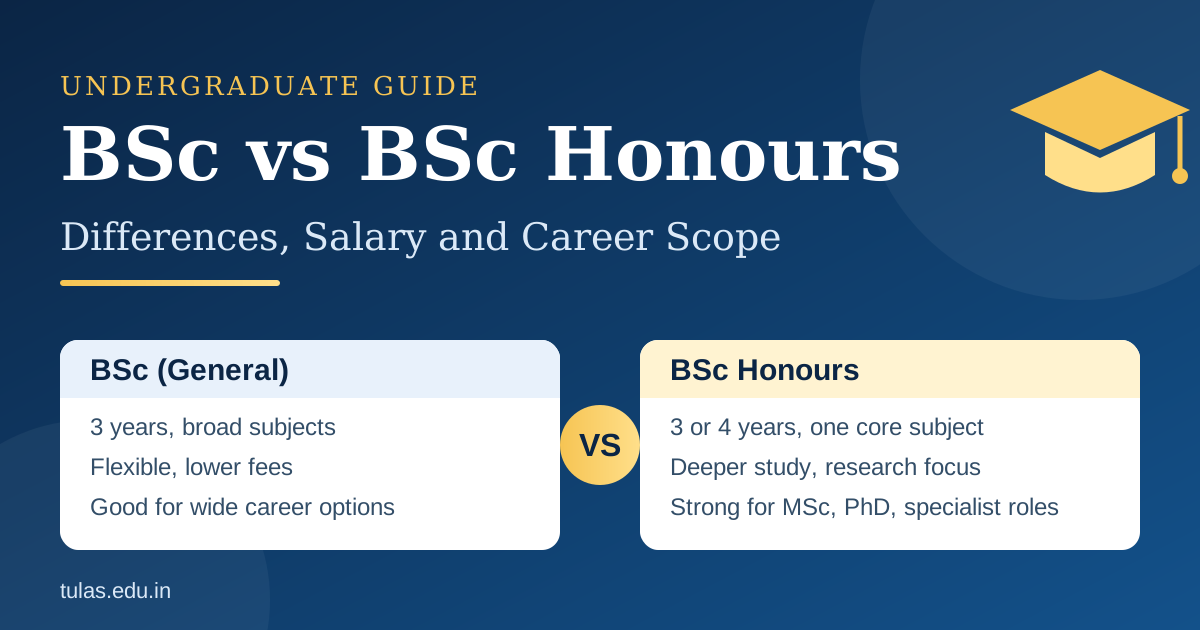
A BSc, also called a general or pass degree, is a bachelor of science programme that spreads your learning across several subjects. A student might study Physics, Chemistry and Mathematics together, or Botany, Zoology and Chemistry.
The idea is breadth. You get a working knowledge of three subjects instead of mastery in one. Classes, labs and exams are balanced across all of them.
This suits students who are still exploring. If you enjoy science but have not picked a final direction, a general degree keeps options open. It also suits those who plan to enter competitive exams, teaching, banking or government services, where a graduation certificate matters more than a specialisation.
What Does BSc Honours Mean?
BSc Honours, often written as BSc Hons, is a specialised version of the degree. You choose one core subject, such as Chemistry, Physics, Mathematics, Computer Science or Biotechnology, and study it in far greater depth.
Think of it as a major in the American sense. You still take a few supporting papers, but the main weight of the course sits on your chosen subject. Practical work is heavier. Project work is common. Examinations ask for analysis, not just recall.
The BSc Honours full form is Bachelor of Science with Honours. The word Honours signals that the student has completed an advanced, subject focused curriculum and met a higher academic standard.
Difference Between BSc and BSc Hons at a Glance
Here is the quick comparison most students are looking for.
Feature | BSc (General) | BSc Honours |
|---|---|---|
Subjects studied | Three or more subjects | One core subject with supporting papers |
Depth of syllabus | Moderate | High, specialised |
Duration | 3 years | 3 years at many universities, 4 years under the NEP structure |
Research or project work | Limited | Strong emphasis, dissertation possible |
Best suited for | Exploring options, general careers, exams | Specialist roles, research, higher studies |
Direct route to PhD | Needs a Master’s first | Possible after the four year research track |
Admission competition | Lower | Often higher, with stricter cutoffs |
Fees | Usually lower | Usually slightly higher |
If you remember only one line, remember this: BSc builds breadth, BSc Honours builds depth.
How NEP 2020 Changed the Picture
The National Education Policy 2020 reshaped undergraduate education in India. Under the UGC curriculum framework that followed, students can now exit or continue at different stages.
A three year programme leads to a regular bachelor degree. A four year programme leads to a bachelor degree with Honours. Students who score well in the first six semesters, usually 75 percent or above, can choose Honours with Research in the fourth year.
This matters for your decision. A graduate of the four year research track can move into a one year master’s programme or, in many cases, go straight towards a PhD. That is a real saving of time compared with the older route.
Not every university has adopted the structure in the same way, and some still run a three year Honours course. Always check the exact programme duration and credit structure before you apply. The official UGC and Ministry of Education websites publish the national framework, and your target college should confirm how it applies in practice.
BSc Honours at Tula’s Institute
To see how the Honours route works in practice, look at the B.Sc. (Hons.) Agriculture programme at Tula’s Institute. It is a four year undergraduate degree with an ICAR aligned curriculum, field and lab based learning and a major capstone project. Eligibility is Class 12 with Physics, Chemistry and Mathematics, Biology or Agriculture, with at least 45 percent marks (40 percent for reserved categories). Diploma holders can join directly in the second year through lateral entry.
Students who like the research track can see ongoing research and projects at the university. You can compare this programme with every other degree on the courses offered page, and use the NIRF India Rankings and AISHE data to compare institutions before you decide.
Syllabus and Depth of Study
Let us take Chemistry as an example.
In a general BSc, a student studies the basics of organic, inorganic and physical chemistry alongside Physics and Mathematics. In BSc Honours Chemistry, the same student studies advanced organic reaction mechanisms, spectroscopy, quantum chemistry, instrumental methods and a long project, with only light coverage of other sciences.
The difference shows up in the lab too. An Honours student might spend an entire semester on one analytical technique. A general student gets a wider but lighter practical schedule.
This depth is why employers in laboratories, pharma units, research bodies and analytics firms often prefer Honours graduates for technical roles. It is also why Honours demands more discipline. The workload is steady, and weak fundamentals get exposed quickly.
Eligibility and Admission
For both degrees, the basic requirement is Class 12 with science subjects from a recognised board. Where the two differ is the subject requirement and the cutoff.
Criteria | BSc (General) | BSc Honours |
|---|---|---|
Qualification | Class 12 science | Class 12 science |
Subject requirement | Flexible | Must have studied the chosen subject, for example Mathematics for Honours Mathematics |
Minimum marks | Usually 45 to 50 percent | Often 50 to 60 percent or higher, depending on the college |
Selection | Merit or entrance | Merit, CUET or college entrance |
Many central and state universities now use CUET scores. Private institutions usually combine merit with a counselling round. If you are comparing colleges, the admission process page of the institution will list exact dates and documents. You can also check the BSc fee structure at Tula’s Institute to understand costs before you apply.
BSc vs BSc Honours Salary in India
Salary is the question students ask most, and it deserves a straight answer. A degree title alone does not fix your pay. Skills, internships, the reputation of your college and the industry you enter matter just as much.
That said, there is a pattern. Honours graduates often start slightly higher in technical roles because employers see deeper subject knowledge. General graduates usually earn well when they combine the degree with a professional skill, such as coding, accounting or teaching certification.
Indicative fresher salary ranges, as commonly reported on job and salary platforms, look like this.
Role | Typical Degree Preference | Approximate Fresher Salary per Year |
|---|---|---|
Lab technician or quality analyst | BSc or BSc Honours | Rs 2.4 lakh to Rs 3.6 lakh |
Data analyst trainee | BSc Honours (Maths, Statistics, CS) | Rs 3.5 lakh to Rs 5.5 lakh |
Research assistant | BSc Honours | Rs 2.5 lakh to Rs 4 lakh |
School teacher (after B.Ed) | BSc | Rs 2.5 lakh to Rs 4.5 lakh |
Pharma or biotech executive | BSc Honours | Rs 3 lakh to Rs 4.8 lakh |
Banking or government exam roles | Any graduate | Rs 4 lakh to Rs 8 lakh and above |
These figures are estimates and change by city, employer and year. Treat them as a planning guide, not a promise.
The real salary gap tends to appear after a few years. Honours graduates who move into research, specialised analytics or senior technical positions often see faster growth because their foundation is stronger. General graduates who build strong professional skills can match or even surpass them. So the BSc vs BSc Honours salary question has no fixed winner. It depends on what you do with the degree.
Career Scope After BSc
A general BSc keeps the road wide. Common paths include:
- Teaching, after a B.Ed
- Government jobs through SSC, banking, railway and state exams
- Laboratory and quality control roles
- Healthcare support and allied sciences
- Further study in MSc, MBA, MCA or law
Because the degree is broad, graduates often combine it with a short certification and move into IT, digital marketing, finance or sales.
Career Scope After BSc Honours
The Honours route points more directly to specialist work. Common paths include:
- Research assistant roles in universities and laboratories
- Data science and analytics, especially with Mathematics, Statistics or Computer Science
- Pharma, chemical and biotech industries
- Environmental and agricultural science
- Scientist trainee roles in government research bodies, after clearing the required exams
- Direct entry to MSc at good universities, often with better chances of admission
The National Career Service portal lists live openings across these sectors, which is a useful way to check demand before choosing a subject.
Higher Studies: MSc, PhD and Beyond
This is where the gap becomes clear.
A student with a general BSc can apply for MSc, but admission usually depends on an entrance test or strong marks. If the MSc subject was one of the three studied, eligibility is straightforward. If not, the student may need to clear bridge courses.
A student with BSc Honours in the same subject has a smoother path. The syllabus already matches the postgraduate level, and many universities give Honours graduates preference. Those who complete the four year research track can reduce their master’s duration to one year in institutions that follow the new framework.
Is BSc Honours equal to MSc? No. Honours is still an undergraduate degree. It is a stronger foundation, not a substitute for a postgraduate qualification. Roles that explicitly ask for a master’s degree will still need one.
Fees and Value for Money
Honours courses sometimes cost a little more because of heavier lab use and extra faculty time. The difference is usually modest and varies by college.
Before deciding, compare the full cost, including lab fees, exam fees and hostel charges. Scholarship schemes can reduce the burden significantly, so check the scholarship options available at your shortlisted institutions. Value for money should be judged against placement support and learning quality, not the sticker price alone.
Which Is Better: BSc or BSc Honours?
Neither is better in every case. The right choice depends on your goal.
Choose BSc Honours if you:
- Know which science subject you love
- Plan to do MSc, PhD or research work
- Want a specialised job in a lab, pharma or analytics
- Are comfortable with a heavier workload
Choose a general BSc if you:
- Are still deciding your career direction
- Plan to appear for government or bank exams
- Want flexibility to switch into management or IT
- Prefer a lighter, more balanced study load
A practical example helps. Riya loved Chemistry and wanted to work in a pharma research lab. She picked Honours and later joined an MSc programme with ease. Her classmate Aman was unsure and wanted to try banking exams. He took a general degree, cleared a bank exam and never looked back. Both made the right choice for their own plans.
A Simple Checklist Before You Decide
Ask yourself these five questions.
- Do I have one subject I would happily study for four years?
- Am I planning a master’s degree or a research career?
- Does my target college offer the Honours subject I want?
- Have I compared the fee structure and the placement record?
- Have I spoken to a current student or an admission counsellor?
If most answers are yes, Honours is a strong fit. If you are unsure, a general degree gives you time to find direction without closing doors.
Frequently Asked Questions
What is the difference between BSc and BSc Honours?
BSc is a general degree that covers several science subjects at a moderate level. BSc Honours focuses on one core subject in greater depth, with more practical and project work. Honours is better for specialisation and higher studies, while a general BSc offers wider flexibility.
Is BSc Honours better than BSc?
BSc Honours is better for students who want specialisation, research or a direct path to advanced study. A general BSc is better for students who want flexibility or plan to take competitive exams. Neither is better for everyone.
Is BSc Honours 3 years or 4 years?
It depends on the university. Many colleges still run a three year Honours programme. Institutions following the NEP 2020 structure offer a four year Honours degree, with an Honours with Research option in the final year.
Does BSc Honours give a higher salary than BSc?
Honours graduates often start slightly higher in technical and research roles, but the difference at entry level is usually small. Long term pay depends more on skills, experience and the industry you choose.
Can I do MSc after a general BSc?
Yes. You can apply for MSc if you studied the relevant subject in your BSc. Some universities may ask for an entrance exam or bridge courses if your subject combination does not match.
Is BSc Honours equal to MSc?
No. BSc Honours is an undergraduate degree. It gives a stronger base, but it does not replace a master’s degree for roles that require one.
Your Next Step Starts Here
Choosing between these two degrees is one of the first big academic decisions you will make, and it deserves a calm, informed look at your own goals. Now that the difference between BSc and BSc Hons is clear, match it with your interests, your budget and your plans for the next five years.
Want to see the campus first? Take the virtual tour, read about our campus or download the brochure. You can also browse more career guides like this one, or apply now for session 2026-27.
If you want guidance from people who handle admissions every day, visit Tula’s Institute and speak to the counselling team, or contact the admission team directly. Review the BSc fee structure to plan your budget, and explore the admission process, scholarship options and placement support before you apply. Your science career begins with one confident decision. Make it an informed one.