Best Medical Courses After 12th Without NEET: High Salary Career Options in 2026 (B.Pharm, D.Pharm and More)
Missed NEET? Compare B.Pharm, D.Pharm and other medical courses after 12th without NEET, with eligibility, salary ranges and career paths for 2026.
Every year, a large number of students prepare for NEET for months and still fall short of the cut off. For many of them, the disappointment feels like the end of the road to a healthcare career. It rarely is. Medical courses after 12th without NEET open real routes into hospitals, labs, pharmaceutical companies and clinical research, and several of these paths pay well once you build some experience.
Why NEET is not the only door into healthcare
NEET decides who gets a seat in MBBS and BDS, and it does that job well for the limited number of seats available. It was never designed to decide who can work in healthcare. Hospitals depend on pharmacists, lab technicians, radiographers, physiotherapists and optometrists every day, and each of those roles requires a formal degree or diploma.
These professionals do not diagnose disease, but they manage medicines, test results, rehabilitation and patient safety. Many of them earn steady incomes, hold recognised licences and build careers that last decades. Students who missed NEET often assume they have lost their place in medicine altogether. In practice, they have simply been given a different starting point.
Which medical courses after 12th skip NEET
Admission rules for healthcare degrees are not uniform across India. Some courses use a state entrance test, some use the class 12 board score, and many private and state universities run their own merit lists. A course that skips NEET in one state may ask for it in another. The safe approach is to read the admission notice of the specific university before you spend money on any application.
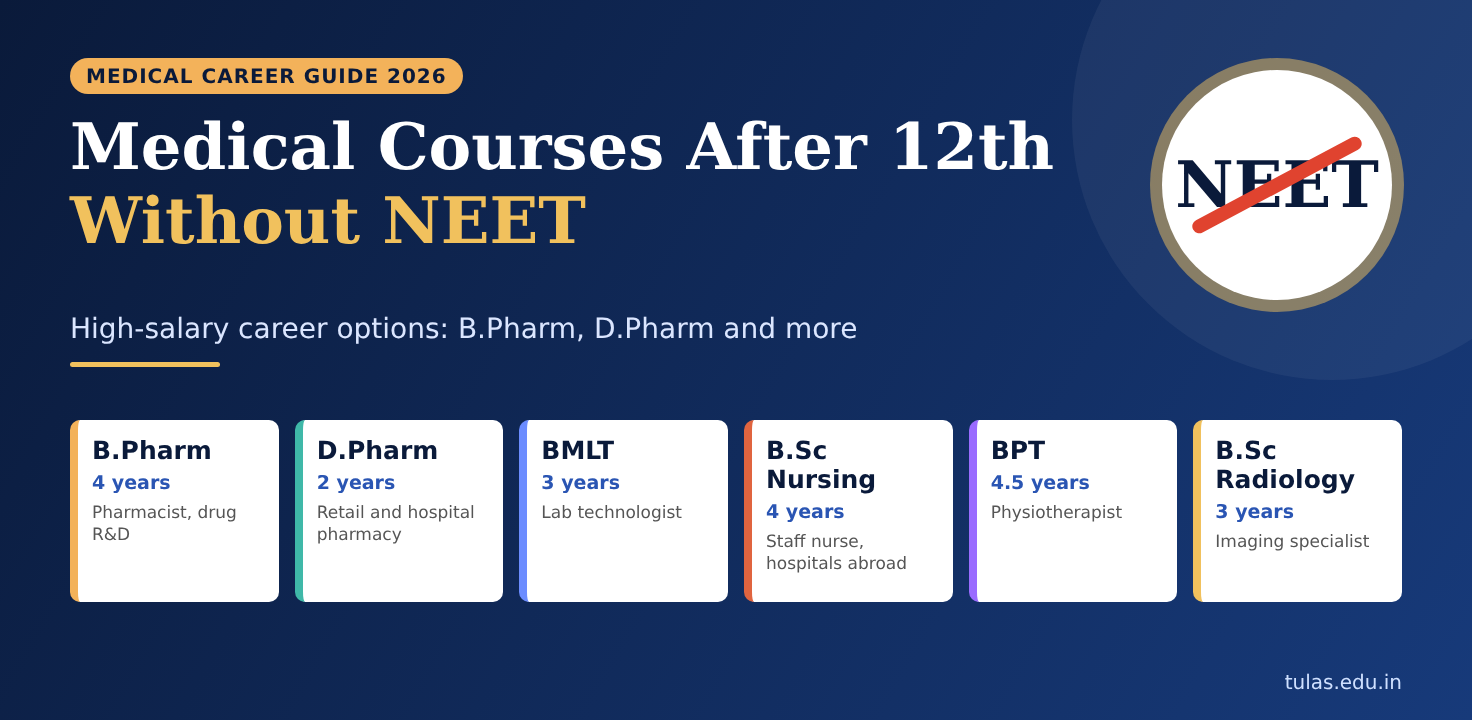
With that caution in mind, several strong options are widely available. Bachelor of Pharmacy (B.Pharm) and Diploma in Pharmacy (D.Pharm) are the most established. Bachelor of Medical Laboratory Technology, Radiology and Imaging Technology, Optometry and Physiotherapy are other common routes, each with its own eligibility rules. Students who enjoy science and hands on work usually find at least one of these a good fit.
The best paramedical courses with high salary without NEET
Paramedical is a broad word, and that is why many students feel lost when they search for it. Some paramedical courses lead to licensed, well regulated jobs with clear pay growth. Others stay at entry level for years unless you add skills or specialise. The difference usually comes down to three things: whether the profession requires a state or national registration, how much clinical or industry demand exists, and whether the field rewards specialisation.
Pharmacy scores well on all three. Pharmacists must be registered, the pharmaceutical industry hires large numbers of graduates every year, and the field opens into regulatory affairs, quality control, pharmacovigilance and clinical research, where pay rises faster. That combination is why career counsellors often point students toward pharmacy first when they want a high salary without NEET.
B.Pharm: the course with the widest career map
Bachelor of Pharmacy is a four year undergraduate programme. Most colleges require Physics, Chemistry and Biology or Mathematics in class 12, and the exact combination depends on the university. Tulas University runs a four year B.Pharm programme at its Dehradun campus, with eligibility set at passing 10+2 with Physics, Chemistry and Biology or Mathematics.
The course covers pharmaceutics, pharmacology, pharmaceutical chemistry and a good amount of practical lab work. What makes it valuable is the range of careers it opens. Graduates work as hospital pharmacists, retail pharmacists, quality control analysts, medical representatives and clinical research associates. Those who keep studying often move into regulatory affairs or pharmacovigilance, which are among the better paying niches in the sector. The Pharmacy Council of India sets the standards that most B.Pharm programmes follow, so it is worth checking that any college you shortlist is approved.
Good students treat the four years as a building period. Internships in hospitals and pharma plants add real experience to your CV, and in the first job search that experience often counts for more than marks alone.
D.Pharm: a shorter route into the profession
Diploma in Pharmacy is a two year course that prepares students to work as registered pharmacists. It suits students who want to start earning sooner or who are not yet sure they want a four year commitment. Eligibility usually requires class 12 with Physics, Chemistry and Biology, and admission often depends on the state pharmacy council and the individual college.
The trade off is clear. D.Pharm holders typically take on dispensing, retail and hospital pharmacy roles. In industry, the ceiling is lower than for a B.Pharm graduate unless students upgrade their qualification. Many students move on later through lateral entry into the second year of B.Pharm, where the rules allow it. If D.Pharm is your priority, compare pharmacy colleges in your own state, because the course is offered by many institutes and their quality varies.
Salary reality check: what the numbers say
Salary is where most articles on this topic become vague, so here is the more careful version. Published figures disagree, sometimes sharply, because they draw on different samples, cities and years. A 2024 guide from UPES, a private university that publishes career content, puts entry level retail or hospital pharmacy pay between Rs 2.5 and 4 lakh per annum. The same guide places clinical research associates between Rs 4 and 6 lakh. Physics Wallah, which tracks monthly figures, puts fresher B.Pharm pay between Rs 12,000 and 25,000 a month, which is broadly consistent with the lower end of that range. The Find My College career guide for 2026 gives regulatory affairs executives Rs 4 to 7 lakh per annum.
Role after B.Pharm | Typical fresher pay reported | Source |
|---|---|---|
Retail or hospital pharmacist | Rs 2.5 to 4 lakh per annum | UPES Editorial Team, 2024 |
Medical representative | Rs 3 to 4 lakh per annum, plus incentives | UPES Editorial Team, 2024 |
Quality control analyst | Rs 3 to 5 lakh per annum | Find My College, 2026 |
Clinical research associate | Rs 4 to 6 lakh per annum | UPES fresher salary guide |
Regulatory affairs executive | Rs 4 to 7 lakh per annum | Find My College, 2026 |
Monthly fresher range across portals | Rs 12,000 to 25,000 per month | Physics Wallah B.Pharm salary guide |
D.Pharm pay is harder to pin down. We could not find a national figure that we would stand behind, so treat any number you see for that course with caution.
The pattern holds even where the exact numbers differ. Starting pay in pharmacy is modest, growth comes from specialisation and experience, and the biggest jumps tend to come from regulatory and clinical research roles. Treat the table as a direction rather than a promise. The most useful step is to ask recent graduates from your target college what their first offers looked like. You can also check the placement highlights page for the outcomes a specific college reports.
How to choose between the options
Three questions help most. First, do you want to work in a hospital, a factory or a research setting? Hospital work leans toward dispensing and clinical pharmacy, while industry roles favour quality control and regulatory skills. Second, can you handle long lab hours and careful record keeping? Pharmacy rewards precision, and a careless approach will slow your progress. Third, what does your state's admission route require? An eligible course you can actually get into is worth more than a famous one you miss.
Students who answer these questions honestly usually find the choice clearer than search results suggested.
Where Tulas University fits into your plan
Tulas University is one place to look if B.Pharm is on your shortlist. The full list of courses, from undergraduate to diploma, is on the all Tulas University programmes page, and the B.Pharm entry sits in the Department of Pharmacy with its eligibility set out clearly. Before you decide, check the B.Pharm fee structure and eligibility at Tulas University so that you can compare costs with other colleges on your list.
The campus is in Dehradun, so factor in travel, accommodation and whether the lab facilities match your plans. The Tulas University brochure is a useful offline reference, and the Tulas University homepage covers accreditations and infrastructure. If you are still weighing non medical options, our guide to engineering courses after 12th with salary covers the other side of the decision. For questions specific to your situation, you can talk to the admissions team directly.
Questions students ask before choosing
If not NEET, then what can I study?
Several healthcare degrees do not depend on NEET. B.Pharm and D.Pharm are the most established, and Medical Laboratory Technology, Radiology and Imaging Technology, Optometry and Physiotherapy are also common. Check each university's admission route, because entrance rules change by state and by college.
Which paramedical course has high salary?
Pharmacy courses usually lead for fresher pay that grows steadily with experience. B.Pharm graduates who move into clinical research or regulatory affairs can start between Rs 4 and 7 lakh per annum, according to recent career guides, while retail and hospital roles begin lower.
Is B.Pharm a good course after 12th without NEET?
Yes, for students who enjoy chemistry and biology and want a licensed profession with many career paths. The course takes four years and early salaries are modest, so the strongest outcomes come from internships, practical skills and steady specialisation.
Can I do B.Pharm with Mathematics instead of Biology?
Some universities accept Physics, Chemistry and Mathematics for B.Pharm, while others require Biology. Eligibility differs, so check the specific university page before applying.
Is D.Pharm worth it compared to B.Pharm?
It depends on your goal. D.Pharm gets you into practice in two years, while B.Pharm opens more doors in industry and research and usually gives a higher career ceiling over time. Many students start with D.Pharm and later upgrade, where lateral entry rules allow.
Where to go from here
Do not let one entrance exam decide your place in healthcare. Compare B.Pharm with the other options in this guide, check eligibility and fees on the Tulas University fee page, and apply early, because seats fill quickly once admissions open. Your next step can be small: pick two courses from this list and read their eligibility rules today. One focused hour of research can shape the next four years. More career guides are on the Tulas blog.