



Important Job Skills for Electronics and Communication Engineering Students
Discover the job profile, salary, job opportunities and key skills for electronics and communication engineers, and learn how to build them during your B.Tech at Tulas, Dehradun.
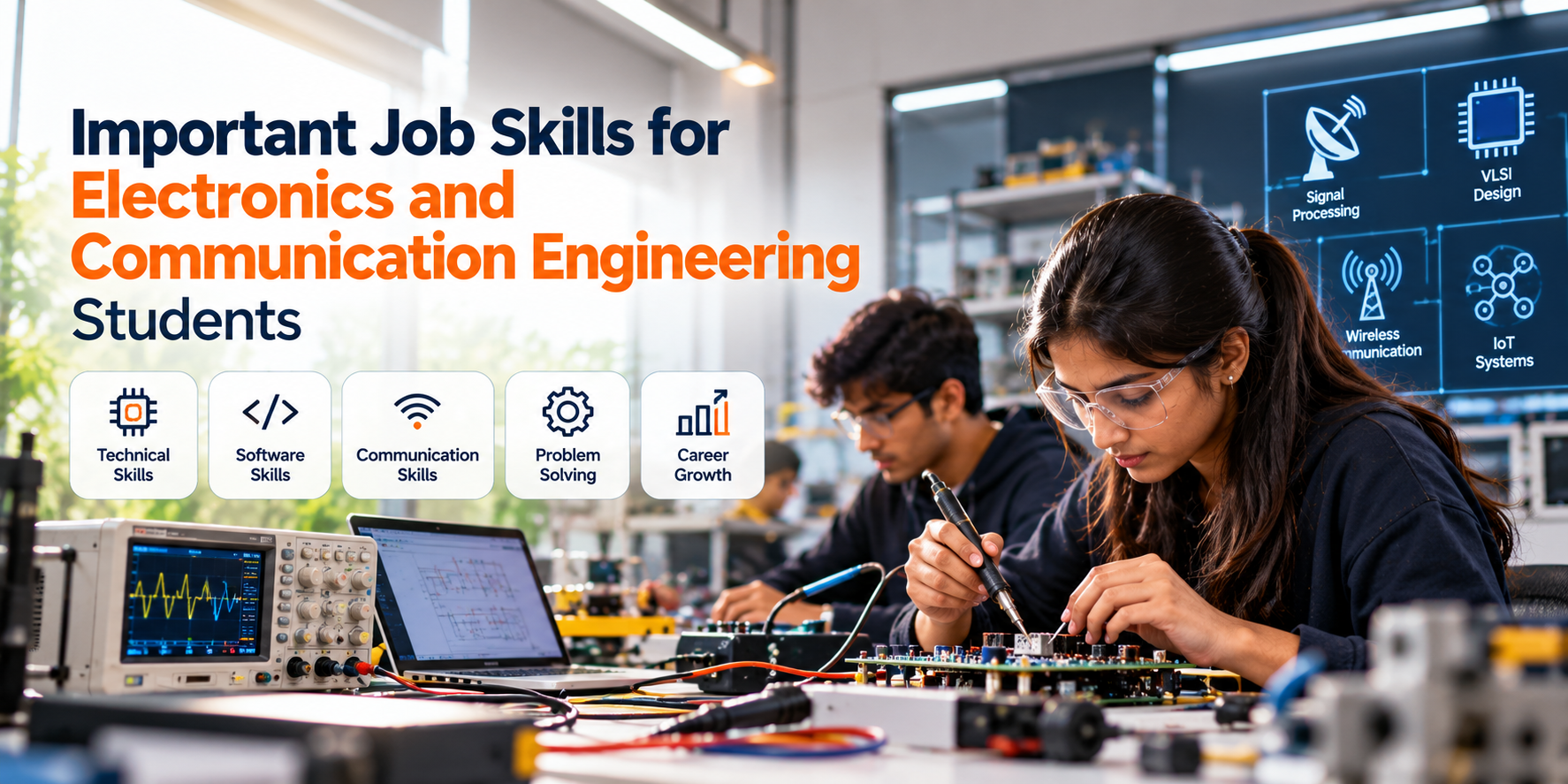
Electronics and communication engineers can work in telecom, semiconductors, embedded systems, IoT, defence, broadcasting and IT. Fresher salaries often range from 3 to 7 lakh per year. The skills that help most are embedded programming, circuit design, VLSI basics, networking knowledge and clear communication.
This guide covers the job profile, salary, job opportunities and the exact skills you can build during your B.Tech.
Job Profile for Electronics and Communication Engineers
The job profile for electronics and communication engineers is wide. These engineers design, test and maintain devices that send, receive and process signals. Think of mobile phones, wireless routers, satellites, smart watches, medical monitors and car electronics.
Daily tasks may include:
- Designing and testing circuits and printed circuit boards
- Writing code for microcontrollers and embedded devices
- Setting up and checking communication networks
- Using simulation tools to test a design before building it
- Fixing faults in hardware and software
- Preparing technical reports and documents
Jobs for Electronics and Communication Engineers
The table below lists popular roles, what each one involves and an indicative fresher salary. Real packages depend on the company, city and your skill level.
Job role
What you do
Indicative fresher salary (per year)
Embedded systems engineer
Write firmware for devices and controllers
3.5 to 7 lakh
VLSI design or verification engineer
Design and test chips
4 to 9 lakh
Network or telecom engineer
Set up and maintain communication networks
3 to 6 lakh
IoT engineer
Connect sensors and devices to the cloud
3.5 to 7 lakh
Test and quality engineer
Check products against standards
3 to 5 lakh
RF engineer
Work with antennas and wireless signals
3.5 to 7 lakh
Software developer
Build applications, often in IT firms
4 to 8 lakh
Job Opportunities for Electronics and Communication Engineers
Job opportunities for electronics and communication engineers exist in many sectors:
- Telecom and 5G network companies
- Semiconductor and chip design firms
- Consumer electronics and appliance makers
- Electric vehicle and automotive electronics companies
- Defence and space organisations
- Medical device manufacturers
- Broadcasting and media technology
- IT services and product companies
- Government and public sector units
India is investing in electronics manufacturing and chip design, which adds more openings every year. You can read about this trend in our article on the future scope of electronics and communication engineering and the career scope of ECE in India.
Electronics and Communication Engineers Salary: What to Expect
Electronics and communication engineers salary depends on skills, company type and experience. Freshers in service companies may start near 3 to 4.5 lakh per year. Those with strong embedded or VLSI skills in product firms can start higher. With five or more years of experience, many engineers move into senior roles with much higher pay.
Three things raise your salary faster than anything else:
- Hands on projects that you can show in an interview
- Skills in a high demand area such as VLSI, embedded or IoT
- Clear communication with teammates and clients
Technical Skills Every ECE Student Should Build
Skill area
Why it matters
Tools to learn
Digital and analog circuits
Base for all hardware work
Multisim, LTspice
Embedded programming
Controls most smart devices
C, C++, Arduino, STM32
VLSI and HDL
Needed for chip design roles
Verilog, VHDL, Vivado
Signal processing
Core of communication systems
MATLAB, Python
Networking basics
Helps in telecom and IoT roles
Packet Tracer, Wireshark
PCB design
Turns circuits into real boards
KiCad, Altium
Programming
Opens software and automation roles
Python, C, Java
Soft Skills That Employers Notice
Technical knowledge gets you an interview. Soft skills help you get the offer and grow in the job.
- Clear spoken and written communication
- Team work and respect for deadlines
- Curiosity and willingness to learn new tools
- Simple, honest problem solving
- Documentation and report writing
How to Build These Skills During Your B.Tech
- Learn C and Python in the first year.
- Build small projects with Arduino or Raspberry Pi in the second year.
- Join a technical club or student chapter to work in a team.
- Complete at least two internships before final year.
- Pick a final year project that solves a real problem.
- Prepare a short portfolio of your circuits, code and reports.
For more guidance, read our step by step guide to prepare for campus placements.
Why Consider Tulas for Electronics and Communication Engineering?
The B.Tech in Electronics and Communication Engineering at Tulas is built to connect classroom learning with real skills. Students can explore:
- Hands on learning in labs and the computer centre
- The IEEE student branch for technical talks and team projects
- The AICTE IDEA Lab for building prototypes
- The Institute Innovation Council for startup and idea support
- Technical fests and student clubs for practice outside the classroom
- Placement highlights for core branches to see how graduates have fared
Students from outside Dehradun can use the hostel and mess facilities. You can also read our guides on the best ECE college and top reasons to choose ECE. For costs, check the fee structure.
Frequently Asked Questions
What jobs can I get after electronics and communication engineering?
You can work as an embedded engineer, VLSI engineer, network engineer, IoT engineer, RF engineer, test engineer or software developer.
What is the salary of an electronics and communication engineer?
Freshers often earn 3 to 7 lakh per year. Pay grows with experience and with skills in areas such as VLSI and embedded systems.
Which skills are most important for ECE jobs?
Embedded programming, circuit design, VLSI basics, signal processing, networking and clear communication are the most useful.
Are there government jobs for ECE engineers?
Yes. ECE graduates can apply to public sector units, defence and space organisations and other government departments through recruitment exams.
Is ECE better than computer science?
Neither is better for everyone. ECE suits students who like hardware and devices, while computer science suits those who prefer software. Many ECE graduates also work in software roles.
Do ECE students need to learn coding?
Yes. Coding in C, C++ and Python helps in embedded, IoT, automation and software roles.
Take the next step with your career by visiting the Tulas homepage or by choosing to apply now.
.png)
.png)